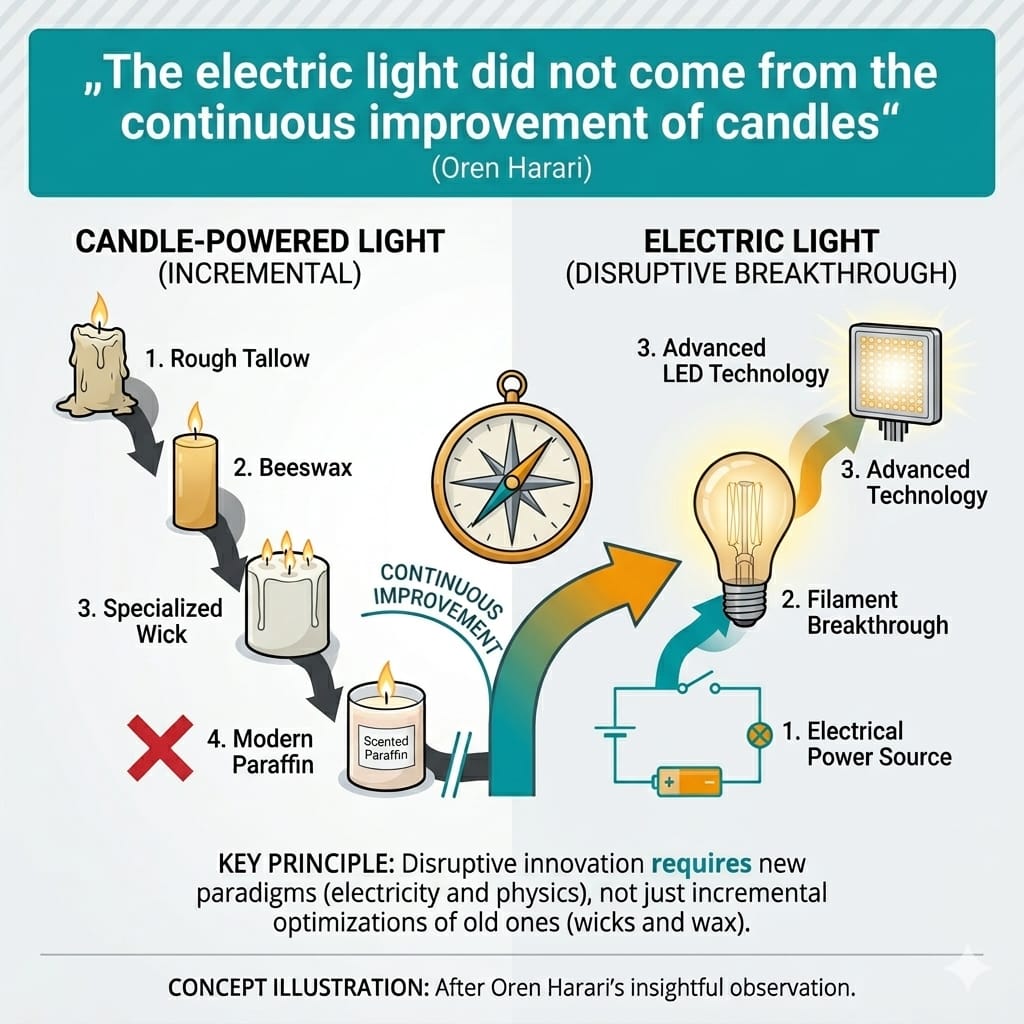
Are we still polishing wicks while the ecosystem demands a new power grid?
The quote"The electric light did not come from the continuous improvement of candles" is more than a business lesson. It is a direct challenge to the humanitarian, development, and business ecosystems operating across the Global South and Africa.
For decades, the "Development Industrial Complex" has been remarkably good at polishing the wick. We have focused on making the "candle" of aid more efficient: better reporting, faster logistics, and more sophisticated project cycles.
But a better candle is still just a flame in the dark; it doesn't change the fact that the room lacks wiring.
The First-Principles Problem
When we deconstruct the challenge to its fundamental truths, we find:
Vulnerability is not an accident: People are not inherently "vulnerable"; they are systemically disadvantaged by ecosystems that lack the "connective tissue" of opportunity.
Linear Solutions vs. Complex Problems: Most aid is "linear" (Project A leads to Output B). However, poverty and exclusion are "complex systems." You cannot fix a non-linear system with a linear project.
The Paradigm Shift: Systems Thinking
To move from the Candle (Incremental) to the Electric Light (Systems Change), we must stop asking "How do we deliver this service?" and start asking "Why doesn't the system provide this naturally?"
From Symptom to Structure: Instead of just filling a gap in a food chain or health clinic, we must address the underlying "physics" of the market and governance systems that created the gap.
From "Project" to "Platform": A project has an end date; a system does not. True transformation happens when we move away from time-bound interventions toward building platforms that enable local businesses, communities, and governments to generate their own solutions.
The "Filament" Breakthrough: In this new paradigm, the breakthrough isn’t a new type of funding, it’s a shift in power and perspective. It is about viewing the African business and social ecosystem not as a recipient of help, but as a complex engine that needs the right "voltage" (policy, infrastructure, and inclusive market systems) to thrive.
The Challenge
The "Continuous Improvement" of the old aid model is comfortable. It’s easy to measure a 5% improvement in a candle's brightness. It is much harder and riskier to build a power plant.
But if we want to truly improve the wellbeing of the most disadvantaged, we have to stop being candle-makers. We must become the architects of a new systemic grid.
Are we brave enough to stop polishing the wax and start re-wiring the system?
#SystemsThinking #GlobalSouth #AfricaDevelopment #FirstPrinciples #SystemsChange #HumanitarianEvolution #SocialImpact #Leadership #ParadigmShift #Innovation #MNMGlobalPartners


